
Epitalon
Khavinson's peptide: telomeres, pineal regulation and cellular longevity.
iThe essentials in 10 seconds
- AEDG tetrapeptide from Prof. Khavinson's work on the pineal gland
- Studied for telomerase activation and telomere maintenance
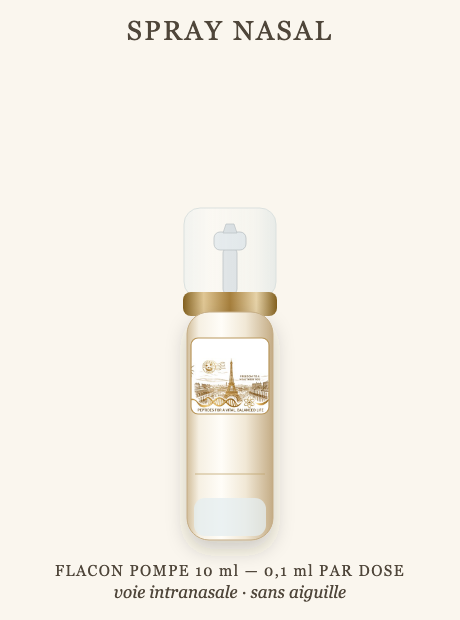
- Dispensed as a nasal spray: 1 spray per nostril, in 10- to 20-day courses
- The reference peptide for longevity and sleep-wake rhythm protocols
IWhat is Epitalon?
Epitalon — also written Epithalon, or AEDG — is a tetrapeptide (alanine-glutamate-aspartate-glycine) derived from epithalamine, a pineal gland extract studied by Prof. Vladimir Khavinson. It is explored along two axes: pineal regulation (sleep-wake rhythm, melatonin) and telomerase activation, the enzyme that maintains telomeres — the protective ends of chromosomes whose shortening accompanies cellular aging.
Experimental peptide: human data remain limited and come mainly from Russian work (Khavinson). It does not replace medical follow-up or the fundamentals (sleep, activity, diet). Use reserved for medical supervision.
The molecules presented on this site are innovative and fall under experimental use. Human data remain limited: a studied mechanism or a preclinical observation is not sufficient to demonstrate a benefit. The regulatory status in Morocco is not established for most of these peptides. Any use is decided within the framework of a medical consultation, with follow-up — never alone, never without an assessment.
IIThe benefits
Studied for telomerase activation, the enzyme that maintains cell telomeres.
Acts on melatonin regulation and sleep quality, particularly after age 50.
Explored in longevity protocols, alongside mitochondrial approaches.
Antioxidant properties studied in cellular aging models.
Explored for its action on age-related neuroendocrine regulations.
Dispensed as a nasal spray: simple, needle-free, suitable for repeated courses.
IIIRecommendations & how to use
Route: intranasal (nasal spray), 1 spray per nostril · Schedule: in 10- to 20-day courses, 1 to 2 courses per year · Timing: morning and/or evening depending on the protocol · Storage: refrigerated (2–8 °C), protected from light, 7 to 14 days after reconstitution.
Nasal bioavailability is low (~5–10%): the nasal dose is higher than the equivalent injectable dose.
| Dosage | Price |
|---|---|
| 10 mg | Provided on request |
Prices are not published online: they are provided on request, during a consultation or by telephone.
IVThe two protocols
Goal: engage in a cellular longevity approach (telomeres, oxidative stress).
Monitoring: sleep quality, general well-being; combine with the fundamentals (activity, diet, sleep).
Goal: support sleep-wake rhythm regulation via the pineal gland.
Monitoring: falling asleep, night awakenings, morning awakening.
VProtocol rules
- Regular bedtime
- Screens and bright light off in the evening
- Note sleep, energy and tolerance
- Keep the pump vial in the refrigerator (2–8 °C)
- Respect the break between two courses
- No use without medical supervision (experimental peptide)
- Never use bacteriostatic water in a nasal spray
- Do not chain courses without a break
- Progressive cancer, pregnancy, breastfeeding: medical advice
- Do not exceed the stated storage duration
VIYour journey in 3 steps
Evaluation of sleep and general well-being, contraindications, protocol provided.
10- to 20-day course, monitoring of sleep and nasal tolerance.
Assessment between two courses, decision to repeat and on associated actives.
VIISide effects & level of evidence
- Headache
- Drowsiness
- Injection-site reaction
- Human data too limited for a complete list
- Pregnancy, breastfeeding
- History of hormone-dependent tumour: caution
- Hypersensitivity
Non-exhaustive list based on the available literature and known class effects; it replaces neither a product label nor an individual medical assessment.
VIIIPublications & references
- Therapeutic Peptides in Orthopaedics: Applications, Challenges, and Future DirectionsRahman et al. · J Am Acad Orthop Surg Glob Res Rev · 2026 · PMID 41490200
- Overview of Epitalon-Highly Bioactive Pineal Tetrapeptide with Promising PropertiesAraj et al. · Int J Mol Sci · 2025 · PMID 40141333
- Therapeutic peptides in gerontology: mechanisms and applications for healthy agingMavrych et al. · Front Aging · 2026 · PMID 42021992
Documentary references: the existence of a publication establishes neither efficacy nor safety for personal use. The regulatory status in Morocco must be verified.