
BPC-157 + TB-500
The repair duo: tendons, muscles, gut, inflammation.
iThe essentials in 10 seconds
- Combination of two complementary repair peptides: BPC-157 + TB-500
- Act on tendons, muscles, joints and the intestinal mucosa
- Subcutaneous injection (or near the area) — 4- to 6-week course
- The reference duo to accelerate healing and recovery
IWhat is BPC-157 + TB-500?
BPC-157 (Body Protective Compound) is a protective gastric protein fragment: it accelerates the healing of tendons, muscles and the intestinal wall, and calms inflammation. TB-500 (Thymosin β4 fragment) promotes the migration of repair cells and tissue flexibility. Together, they cover local and systemic repair.
Peptides widely used in sports medicine but off-label: use reserved for a supervised medical setting, in the absence of contraindications (progressive cancer).
The molecules presented on this site are innovative and fall under experimental use. Human data remain limited: a studied mechanism or a preclinical observation is not sufficient to demonstrate a benefit. The regulatory status in Morocco is not established for most of these peptides. Any use is decided within the framework of a medical consultation, with follow-up — never alone, never without an assessment.
IIThe benefits
Accelerates the healing of tendons and ligaments (tendinopathies, sprains) and reduces pain.
Supports the repair of exertion-induced micro-lesions and reduces soreness and stiffness.
BPC-157 protects and repairs the intestinal mucosa (ulcers, inflammation, permeability).
Reduces inflammation at the injury site — useful in chronic joint pain.
Shortens recovery time after injury or after intense exertion.
Improves elasticity and local circulation, complementing BPC-157.
IIIRecommendations & how to use
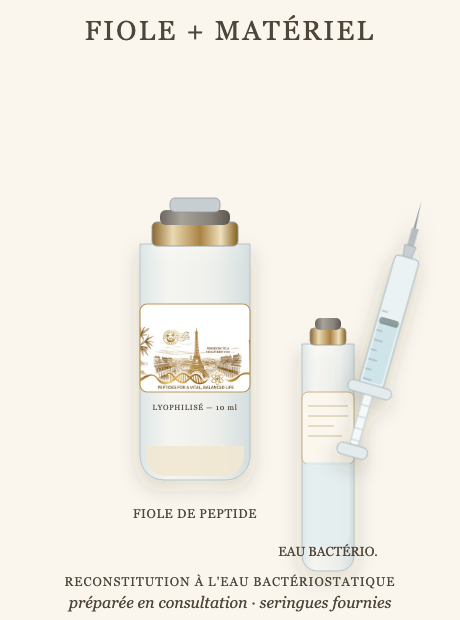
Route: subcutaneous injection — general (abdomen) and/or near the injured area · Frequency: regular injections over the day or week depending on the form · Storage: refrigerated (2–8 °C).
The duo does not replace immobilization/rehabilitation when indicated.
| Dosage | Price |
|---|---|
| 5 + 5 mg | Provided on request |
| 10 + 10 mg | Provided on request |
Prices are not published online: they are provided on request, during a consultation or by telephone.
IVThe protocols
Objective: accelerate the healing of an injury (tendon, muscle, joint) and calm inflammation.
Monitoring: progression of pain and mobility; combine rehabilitation and rest.
Objective: reduce recovery times and protect tendons and muscles in athletes.
Combine: hydration, protein, sleep and load management.
Objective: the same repair logic in a single vial — GLOW = GHK-Cu + BPC-157 + TB-500 (70 mg) · KLOW = GLOW + anti-inflammatory KPV (80 mg).
The blend is rich in GHK-Cu: for an injury, supplement with separate TB-500 (2 mg ×2/week). No clinical trial has evaluated these combinations.
VProtocol rules
- Continue rehabilitation and rest when indicated
- Adequate hydration and protein intake
- Quality sleep: the engine of repair
- Note pain and mobility for monitoring
- Store vials in the refrigerator
- No self-injection without medical training
- Do not force exertion on an area being repaired
- Do not chain courses without a break
- Never mix peptides in the same vial
- Progressive cancer: contraindication — medical advice mandatory
VIYour journey in 3 steps
Evaluation of the injury, contraindications, injection training, protocol provided.
Regular injections, monitoring of pain and mobility, associated rehabilitation.
Recovery assessment, decision on next steps (break, new course if needed).
VIISide effects & level of evidence
- Injection-site pain or redness
- Dizziness, light-headedness
- Nausea
- Fatigue, headache
- Active cancer or cancer history (angiogenesis)
- Pregnancy, breastfeeding
- Children and adolescents
- Uncontrolled autoimmune disease: caution
Non-exhaustive list based on the available literature and known class effects; it replaces neither a product label nor an individual medical assessment.
VIIIPublications & references
- Multifunctionality and Possible Medical Application of the BPC 157 Peptide-Literature and Patent ReviewJózwiak et al. · Pharmaceuticals (Basel) · 2025 · PMID 40005999
- Emerging Use of BPC-157 in Orthopaedic Sports Medicine: A Systematic ReviewVasireddi et al. · HSS J · 2025 · PMID 40756949
- Intra-Articular Injection of BPC 157 for Multiple Types of Knee PainLee E, Padgett B · Altern Ther Health Med · 2021 · PMID 34324435
Documentary references: the existence of a publication establishes neither efficacy nor safety for personal use. The regulatory status in Morocco must be verified.