
GHK-Cu
Copper peptide: collagen, healing, skin and hair.
iThe essentials in 10 seconds
- Copper peptide naturally present in plasma and saliva
- Stimulates collagen and elastin: firmness, healing, hair
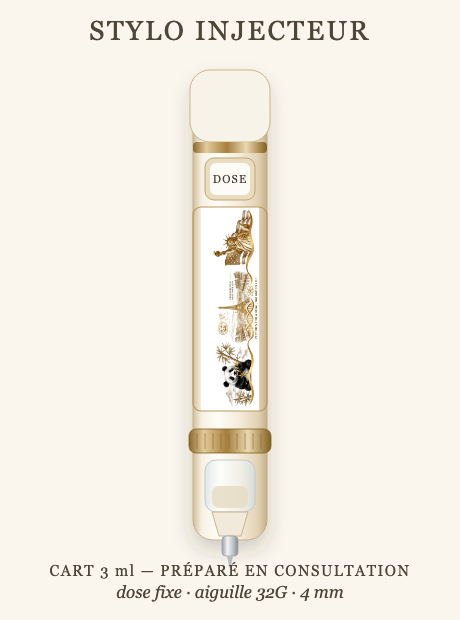
- As an injector pen (subcutaneous, fixed dose) — or topical application (cream, serum)
- Reference peptide for regenerative skin care
IWhat is GHK-Cu?
GHK-Cu is a small copper-bound peptide, naturally present in plasma, saliva and urine. It stimulates the production of collagen and elastin, promotes healing and tissue regeneration, and has an antioxidant action. Its level decreases with age, which explains its popularity in skin and hair care.
Widely used in professional cosmetics (topical). The injectable form is given with the pen, under supervision: quality and sterility are crucial. Copper requires cycles with a break (4 to 6 weeks, then 2 to 4 weeks off).
The molecules presented on this site are innovative and fall under experimental use. Human data remain limited: a studied mechanism or a preclinical observation is not sufficient to demonstrate a benefit. The regulatory status in Morocco is not established for most of these peptides. Any use is decided within the framework of a medical consultation, with follow-up — never alone, never without an assessment.
IIThe benefits
Boosts the synthesis of collagen and elastin: firmer, denser skin.
Accelerates skin repair and improves scar quality.
Stimulates the hair follicle — relevant in hair loss and thinning.
Antioxidant and anti-inflammatory action: protects the skin from oxidative stress.
Contributes to a more even and radiant complexion (regular use).
Supports tissue renewal and skin quality with age.
IIIRecommendations & how to use
Route: superficial subcutaneous with the injector pen (32G · 4 mm needle) or topical application · Dose: 1 to 2 mg/day, fixed dose — the pen simplifies the daily routine · Frequency: daily, in cycles of 4 to 6 weeks then a 2 to 4 week break · Storage: refrigerated (2–8 °C), protected from light, 28 days after reconstitution.
Avoid contact with eyes; sun protection essential.
| Dosage | Price |
|---|---|
| 100 mg | Provided on request |
Prices are not published online: they are provided on request, during a consultation or by telephone.
IVThe protocols
Goal: improve firmness, radiance and evenness of complexion.
Monitoring: before/after photos, hydration, tolerance.
Goal: support the hair follicle and scar quality.
Monitoring: hair density, area appearance, tolerance.
Goal: boost collagen and tissue repair in a single injection — blend GHK-Cu + BPC-157 + TB-500 (known as GLOW).
Reference per component: GHK-Cu 1–2 mg/day, BPC-157 250–500 µg/day, TB-500 rather 2 mg ×2/week. The 5:1:1 ratio is rich in GHK-Cu: for an injury, supplement with separate TB-500. No clinical trial has evaluated the combination.
Goal: the same base as GLOW, reinforced with KPV (anti-inflammatory tripeptide): skin, mucous membranes and low-grade inflammation.
Reference per component: GHK-Cu 1–2 mg/day, KPV 300–500 µg/day, BPC-157 300–500 µg/day, TB-500 2 mg ×2/week then 2 mg/week. A blue-green line at the injection site is possible (copper, harmless). No clinical trial has evaluated the blend.
VProtocol rules
- Daily sun protection (SPF)
- Regular skin hydration
- Before/after follow-up photos
- Consistency over several weeks
- Store the cartridge in the refrigerator (2–8 °C)
- Avoid contact with eyes
- Do not mix with irritating actives without advice
- No use of the pen without medical training
- Do not use on damaged or infected skin without advice
- Known allergy to copper or peptides: medical advice
VIYour journey in 3 steps
Evaluation of skin/hair, goals, reference photos, protocol provided.
Pen injections (or applications) depending on the area, tolerance monitoring.
Before/after comparison, decision on continuation and associated actives.
VIISide effects & level of evidence
- Redness, itching, tightness at application site
- Skin irritation (topical)
- Pain, bruising (injection)
- Transient tingling
- Copper or excipient allergy
- Wilson's disease
- Broken skin or infected wound (topical)
- Pregnancy, breastfeeding: caution
Non-exhaustive list based on the available literature and known class effects; it replaces neither a product label nor an individual medical assessment.
VIIIPublications & references
- Regenerative and Protective Actions of the GHK-Cu Peptide in the Light of the New Gene DataPickart L, Margolina A · Int J Mol Sci · 2018 · PMID 29986520
- The potential of GHK as an anti-aging peptideDou et al. · Aging Pathobiol Ther · 2020 · PMID 35083444
- Injectable Peptide Therapy: A Primer for Orthopaedic and Sports Medicine PhysiciansMayfield et al. · Am J Sports Med · 2026 · PMID 41476424
Documentary references: the existence of a publication establishes neither efficacy nor safety for personal use. The regulatory status in Morocco must be verified.